Love this blog post published in the Washington Post by Dylan Matthews. Look at the flowchart below, but it's worth reading his WaPo article here.
Showing posts with label not. Show all posts
Friday, 13 September 2013
Sunday, 24 February 2013
I Am Taking a Reflux Medication & My Symptoms are Not Improving!
Posted on 06:23 by Unknown
On an almost daily basis, I get an email from somebody with the same exact question or near-variation:
Summary
"Dear Dr. Chang,
I have been taking a [insert reflux medication] for [insert number] weeks and I see no improvement in my [insert symptom]. What should I do?"
The reflux medication typically mentioned include nexium, dexilant, prilosec, prevacid, protonix, or some other proton pump inhibitor.
The most common symptoms typically mentioned include:
• Globus
• Cough
What Should You Do?
Well, assuming you never have taken a reflux medication in the past, proton pump inhibitors work extremely well in suppressing acid; even at low dosages.
As such, if you indeed have been taking a proton pump inhibitor for at least 3 weeks and see no improvement in symptoms, one must consider the possibility that acid reflux may not be the problem.
I rarely if ever just increase the dosage of a reflux medication in somebody who previously was never on one. Increasing the medication dosage MIGHT be considered only if somebody has already been on reflux medication for some time baseline.
So if acid reflux is not the problem, what may be causing above-mentioned symptoms?
There could be an anatomic problem...
• Cricopharyngeal spasms/hypertrophy
• Esophageal dysmotility
• Esophageal web or stricture
etc
Essentially, there's something wrong with your swallowing tube such that things back up into the throat causing symptoms. Think of it like a clogged sink... the pipe (esophagus) has a physical issue that causes water to backup into the sink (throat).
Workup to evaluate these possibilities include trans-nasal endoscopy, EGD, barium swallow, and/or manometry.
It could still be a reflux problem...
Just maybe, it's NOT acid reflux however, but mucus or non-acid reflux. Standard reflux medications do not work for non-acid reflux. The best way to evaluate this possibility is to undergo a 24 hour multichannel pH and impedance testing. Of note, BRAVO or pH monitoring alone is NOT good enough. Impedance must be measured as well as having sensors near the throat level.
In the meantime, one could also try avoiding eating anything that contains dairy, egg, and wheat (flour). These foods are considered highly mucogenic (most people can relate to the fact that when drinking too much milk, the mouth and throat can get phlegmy).
Is it allergy?
Post-nasal drainage can sometimes lead to throat symptoms. If you do have some sino-nasal allergies, try taking a steroid nasal spray and an anti-histamine nasal spray. Oral medications typically do not work as well.
There's also a condition known a eosinophilic esophagitis that can cause throat symptoms. The only way to diagnose this condition is an upper endoscopy (EGD) with biopsies of the esophageal lining.
Summary
Now this article just scratches the surface in FULLY addressing an individual patient's throat symptoms. After all, not everybody is exactly the same. For a more in-depth evaluation and individualized treatment of YOUR throat issues, please make an appointment with your ENT.
Here are some related articles that may be helpful:
Saturday, 29 December 2012
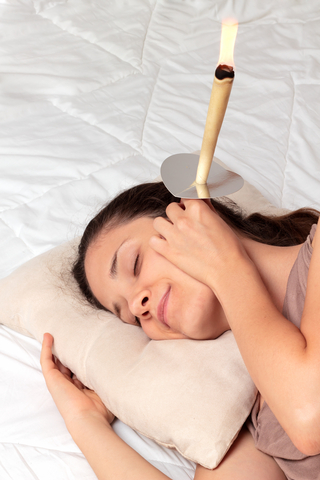
Do Ear Candles Actually Remove Earwax? [video]
Posted on 13:56 by Unknown
About once a week, I have a patient who presents to my clinic with a history of ear candling
for earwax removal due to clogged ear sensation.
About once a month, I have a patient with ear canal and/or eardrum damage due to using an ear candle in an attempt to remove earwax.
I even have on occasion patients who I thoroughly remove earwax under the microscope, who than go home, perform an ear candle, and inform me of all the "earwax" that I missed.
Well... I've decided to make a video (see below) illustrating how ineffective ear candling is in removing earwax as well as how it could be even harmful. The other aspect of this educational video is to show how misleading ear candling
is when it comes to earwax.
Please note that we are aware that the "official" way to use an ear candling
is small end down into the ear, but for this video, we have elected to use it the way most "lay" public would (small end up).
[SPOILER ALERT!!! A burning ear candle actually creates debris that looks like earwax. As such, an ear candle "works" whether it is in the ear or not.]
References:
Ear candles: Efficacy and safety. Laryngoscope 106 (10): 1226–9.
Ear candling: Should general practitioners recommend it? Can Fam Physician 53 (12): 2121–2. PMC 2231549. PMID 18077749.
Ear candles can be purchased on Amazon.com
for you to "experiment" with.
About once a month, I have a patient with ear canal and/or eardrum damage due to using an ear candle in an attempt to remove earwax.
I even have on occasion patients who I thoroughly remove earwax under the microscope, who than go home, perform an ear candle, and inform me of all the "earwax" that I missed.
Well... I've decided to make a video (see below) illustrating how ineffective ear candling is in removing earwax as well as how it could be even harmful. The other aspect of this educational video is to show how misleading ear candling
Please note that we are aware that the "official" way to use an ear candling
[SPOILER ALERT!!! A burning ear candle actually creates debris that looks like earwax. As such, an ear candle "works" whether it is in the ear or not.]
References:
Ear candles: Efficacy and safety. Laryngoscope 106 (10): 1226–9.
Ear candling: Should general practitioners recommend it? Can Fam Physician 53 (12): 2121–2. PMC 2231549. PMID 18077749.
Wednesday, 14 November 2012
Video and Audio Recording with RCA Connectors: Primer for Surgeons
Posted on 04:47 by Unknown
In the medical world, video recording of surgical procedures is not unusual, especially when it comes to endoscopy.
A camera attached to an endoscope throws up a live image to a screen for the surgeon (and others) to watch. Video output for recording is now standard in such situations.
The monitor where the endoscopy procedure is viewed itself contains video output plugs.
The endoscopy equipment itself like the KayPentax EPK-1000 contains not just one video output, but 3... Two S-video and one RGB.
As such, one could hook up literally any type of recording device and get a beautiful video copied into any type of media very easily whether laptop computer, VHS, CD, thumb drive, etc.
HOWEVER, audio recording simultaneously with endoscopy is not typically a built-in feature and as such requires some MacGyver action.
Why in the world would a surgeon want to record audio? Well, take ENT surgeons who perform vocal cord procedures where the voice is the main outcome measure. It would be great to be able to record not just the video, but the audio of the patient's voice as the procedure is performed.
So what to do?
The simplest way to record audio and video is to take a camcorder and record the screen. The camcorder will be able to record the video (via shooting the monitor) and has built in microphone to record the surrounding audio. One can also attach a lapel microphone and plug it into the audio jack of the camcorder if available.
The downside with this simple method is the video quality. You are after all recording a screen rather than getting the pure digital video signal which would provide the best video picture.
Well, the surgeon will need to obtain a digital AV converter box which has the ability to merge separate video and audio signals and merge it into a single AV signal that is then fed into a computer to record. With this setup, the computer is tricked into thinking the video and audio as coming from a single source like a camcorder.
The problem is that all AV converter boxes (as of Nov 2011) utilizes RCA audio ports (red and white).
One can not simply buy a microphone with appropriate RCA adapters and plug it into the AV converter box. IT WILL NOT WORK!
Why? Because RCA connectors contain no power. Typically, RCA connectors go from something that already has a power source like a DVD player, camcorder, or TV. The current crop of digital AV converter boxes assumes that the user is trying to copy a movie or show onto a computer.
But for the surgeon, that's not what is occurring.
We literally just want to connect a microphone (which inherently has no power supply) to the RCA audio ports on the AV converter box.
In order to do this, a power supply needs to be provided to the microphone BEFORE plugging it into the RCA ports.
What is this power supply unit? It's called a microphone pre-amp.
So the connections go something like this:
A variety of plug converters will be required in order to plug each component to each other.
For those who want to duplicate what I've specifically done, here are the components (Amazon links provided below):
1) Microphone - Olympus ME-51S Stereo Microphone
2) Microphone Pre-Amp - ART Tube MP Studio Mic Preamp
3) AV Converter Box - Canopus ADVC110 Converter
The monitor where the endoscopy procedure is viewed itself contains video output plugs.
The endoscopy equipment itself like the KayPentax EPK-1000 contains not just one video output, but 3... Two S-video and one RGB.
As such, one could hook up literally any type of recording device and get a beautiful video copied into any type of media very easily whether laptop computer, VHS, CD, thumb drive, etc.
HOWEVER, audio recording simultaneously with endoscopy is not typically a built-in feature and as such requires some MacGyver action.
Why in the world would a surgeon want to record audio? Well, take ENT surgeons who perform vocal cord procedures where the voice is the main outcome measure. It would be great to be able to record not just the video, but the audio of the patient's voice as the procedure is performed.
So what to do?
The simplest way to record audio and video is to take a camcorder and record the screen. The camcorder will be able to record the video (via shooting the monitor) and has built in microphone to record the surrounding audio. One can also attach a lapel microphone and plug it into the audio jack of the camcorder if available.
The downside with this simple method is the video quality. You are after all recording a screen rather than getting the pure digital video signal which would provide the best video picture.
Well, the surgeon will need to obtain a digital AV converter box which has the ability to merge separate video and audio signals and merge it into a single AV signal that is then fed into a computer to record. With this setup, the computer is tricked into thinking the video and audio as coming from a single source like a camcorder.
The problem is that all AV converter boxes (as of Nov 2011) utilizes RCA audio ports (red and white).
One can not simply buy a microphone with appropriate RCA adapters and plug it into the AV converter box. IT WILL NOT WORK!
Why? Because RCA connectors contain no power. Typically, RCA connectors go from something that already has a power source like a DVD player, camcorder, or TV. The current crop of digital AV converter boxes assumes that the user is trying to copy a movie or show onto a computer.
But for the surgeon, that's not what is occurring.
We literally just want to connect a microphone (which inherently has no power supply) to the RCA audio ports on the AV converter box.
In order to do this, a power supply needs to be provided to the microphone BEFORE plugging it into the RCA ports.
What is this power supply unit? It's called a microphone pre-amp.
So the connections go something like this:
microphone on patient --> microphone pre-amp --> AV converter box --> computer to record
A variety of plug converters will be required in order to plug each component to each other.
For those who want to duplicate what I've specifically done, here are the components (Amazon links provided below):
1) Microphone - Olympus ME-51S Stereo Microphone
2) Microphone Pre-Amp - ART Tube MP Studio Mic Preamp
3) AV Converter Box - Canopus ADVC110 Converter
Subscribe to:
Posts (Atom)


